

 eng
 English
 Español
 русский
 عربى
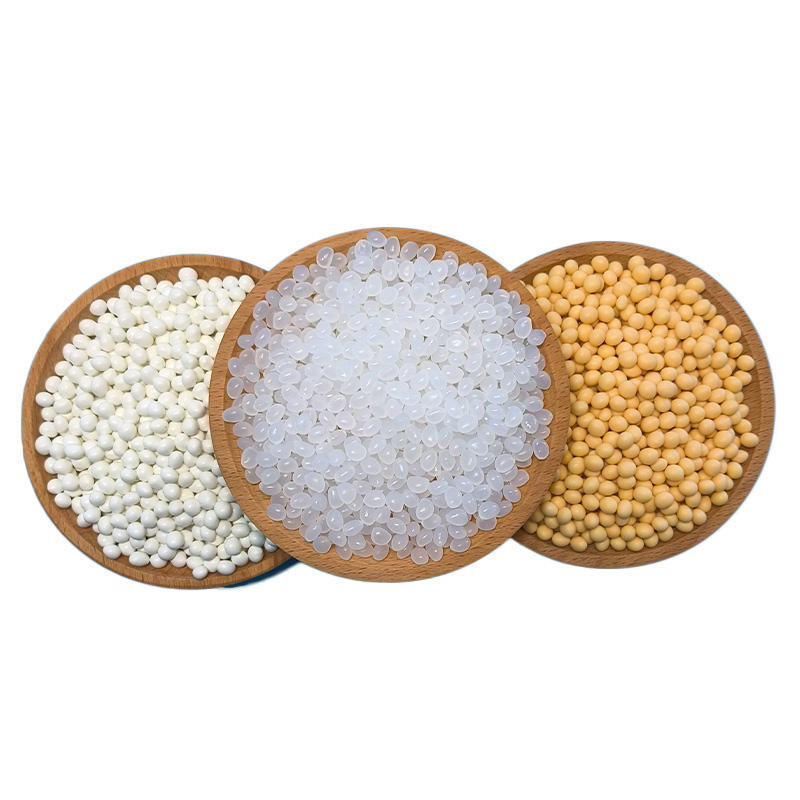
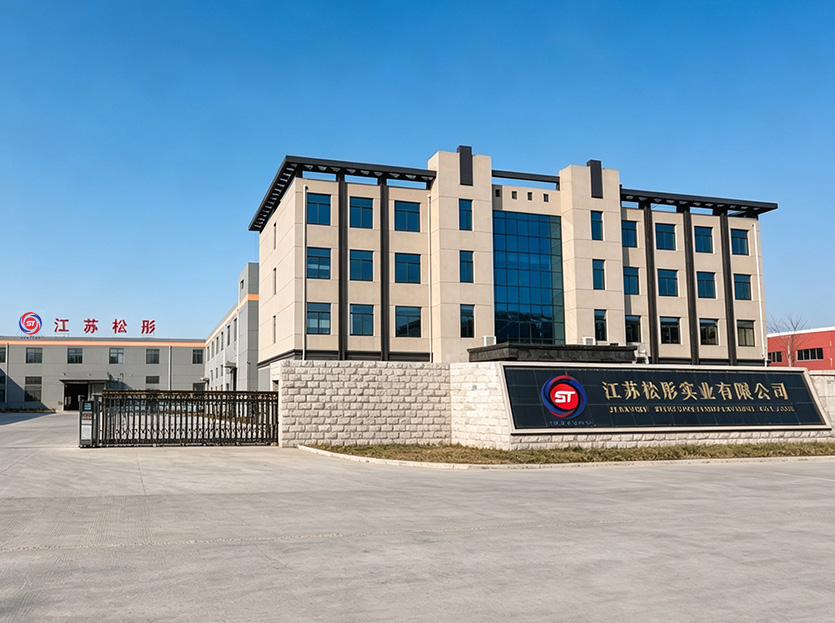



As an Edge Banding Hot Melt Adhesive manufacturer, Shanghai Suntung Industry Co., Ltd. supplies the bonding side of the edge joint as well as the edge itself: EVA hot melt granulate for automatic edge banders, specified together with the PVC, ABS, acrylic, melamine, veneer and PET-film banding we produce.
We have made edge banding since 2005 and now run a 21,500 m² production base in Taizhou, Jiangsu, shipping to more than 90 countries. Adhesive is selected with the banding material, the panel and the machine in view, so melt behaviour, open time and the finished bond are settled as one specification rather than two separate purchases.
What the Adhesive Has to Do on an Edge Banding Line
Hot melt for edge banding is a processing material before it is a chemical one. It has to melt predictably in the pot, wet the machined panel edge and the back of the banding within the few seconds the line allows, and then hold that joint through end trimming, radius scraping and buffing without reading through the strip.
- Wetting: flows into the panel edge and the primed or unprimed banding back without starving either surface.
- Open time: still tacky when the strip reaches the pressure roller at the speed the line actually runs.
- Green strength: the joint survives the trimming station a few metres downstream.
- Thermal stability: no charring, skinning or viscosity drift across a full shift in the pot.
- Service heat resistance: holds in kitchens, vehicles and warm-climate warehouses.
- Clean running: minimal stringing, low smoke and a quick purge at changeover.
Adhesive Matching Across Our Edge Banding Range
The grade follows the edge material and the panel rather than the adhesive catalogue alone. These are the combinations we specify most often, and each one shifts the balance between viscosity, open time and coat weight.
| Edge material | Panel substrate | Adhesive behaviour we match | Line considerations |
|---|---|---|---|
| PVC Edge Banding | MDF, particleboard, plywood | Medium-viscosity EVA, short to medium open time | Runs at the highest line speeds; pot temperature stability matters more than a grade change |
| ABS Edge Banding | MDF, particleboard, plywood | EVA with a slightly longer open time for the denser, stiffer strip | Pressure roller and cooling distance set so the joint is closed before trimming |
| 3D acrylic | Primed MDF | EVA tuned for non-porous backs, with a controlled coat weight | Slower feed and longer open time; avoid over-wetting glossy backs |
| Melamine and paper | Particleboard, MDF | Lower-viscosity EVA that penetrates the paper back | Coat weight kept in check to prevent strike-through |
| Veneer | Plywood, MDF | Short open time with a controlled bead and minimal squeeze-out | Sanding and lacquering follow, so the glue line must stay clean |
| Metallic PET film | MDF, particleboard | EVA selected to prevent read-through on thin film | Lower roller pressure and temperature verified at the nip |
Critical Specifications Settled Before Production
A workable grade is defined by a small number of values, and each one is agreed against your machine settings and the conditions the finished furniture will meet.
- Softening point and heat resistance against the highest service temperature the panel will see.
- Melt viscosity at the working temperature, matched to roller or slot-nozzle application.
- Open time against the distance between applicator and pressure roller at production speed.
- Thermal stability and filler content for a full shift without charring or drift.
- Colour and opacity, so the glue line does not show through light or translucent banding.
- Granule form, bulk density and moisture for even melting in the pot.
- RoHS compliance for markets with restricted-substance requirements.
Workpiece and Shop Conditions That Change the Bond
Two plants running the same adhesive on the same banding can still get different results. The variables below explain most of that gap and are part of how we match a grade to a site.
- Edge quality and dust extraction: a crushed or dusty panel edge starves the bond regardless of grade.
- Core moisture: damp MDF and particleboard release steam at the glue line and weaken the joint.
- Banding back surface: primed, unprimed, glossy or film-laminated backs take up adhesive differently.
- Banding thickness and rigidity: thin PVC and heavy ABS respond differently to the same roller pressure.
- Ambient temperature: a cold shop lengthens open time, a hot one shortens it, and neither is visible on the controller.
Line Integration, Start-Up and Maintenance
Adhesive reaches full performance only when the machine around it is set to the same working point. The settings below are the ones we review with your line team at commissioning and after any material change.
- Pot and nozzle temperature verified with a probe, not only read from the display.
- Roller gap and pressure set to the banding thickness and strip stiffness.
- Feed rate and line speed kept inside the open time of the grade in use.
- Cooling distance before the trimming station, so the joint is not cut while still soft.
- Purge and cleaning schedule fixed; granulate stored sealed, dry and at ambient temperature.
Quality Assurance, Testing and Documentation
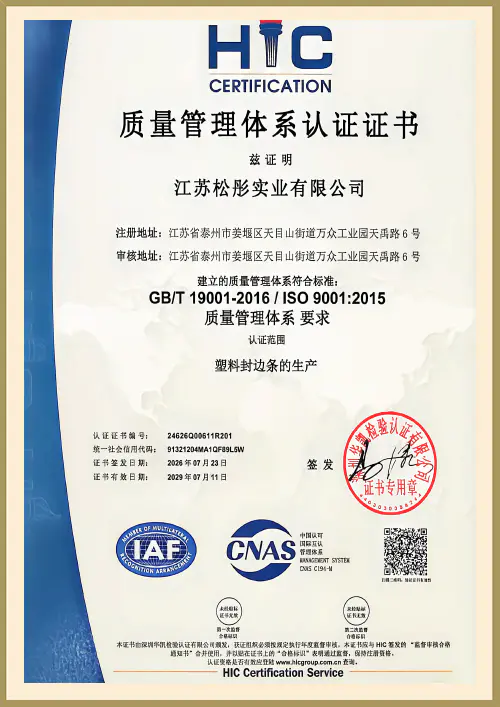
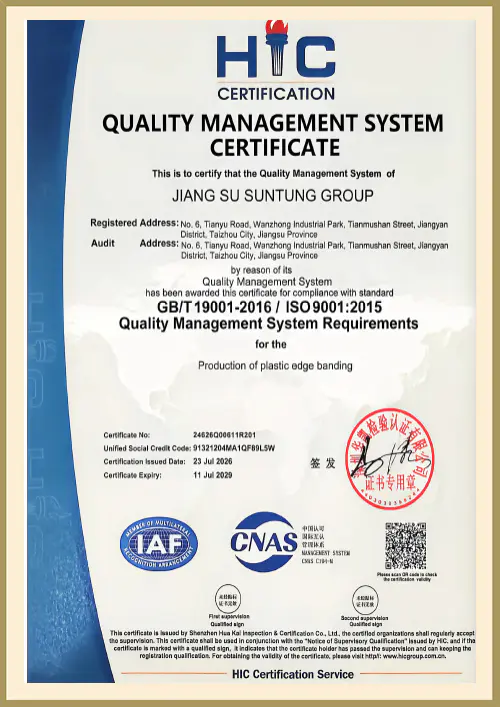
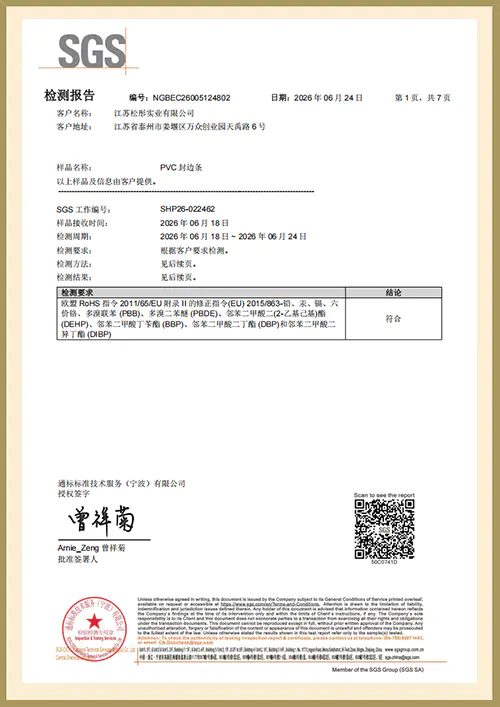
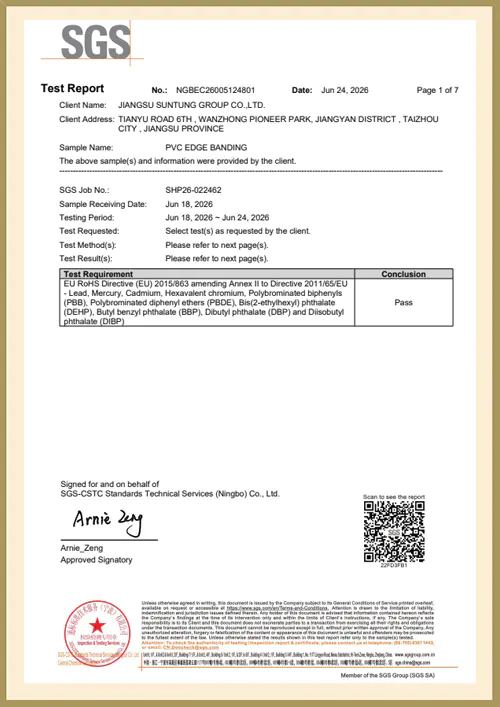
Production runs under ISO 9001:2015 at the Taizhou factory, and the edge banding we supply is RoHS compliant. Bonding and sealing are verified in machine trials that reproduce the customer's line rather than on a laboratory press alone, and SGS test reports and compliance documents are issued on request.
- First-article peel test on production panels at the specified line speed.
- Seam appearance checked after trimming, scraping and buffing.
- Heat resistance test at the service temperature agreed for the project.
- Cold-bend check for destinations with low winter temperatures.
- Batch traceability from granulate lot to packed carton.
Capacity, Packing and Delivery
Twenty-three automatic lines across the 21,500 m² plant produce around 25 million metres of edge banding a month. Adhesive, PVC profiles and screw caps are supplied alongside in mixed container programmes shipped from Shanghai, which keeps banding and glue on one supply cycle instead of two.
Pack format, unit weight, pallet configuration and carton marking are agreed per order, and packed goods are checked for labelling and packaging integrity before release.
Information We Use to Configure Your Solution
A shortlist and a working sample follow from a small set of line facts:
- Banding material, thickness and back-surface treatment
- Panel type, density and edge finish
- Edge bander make and model, plus applicator type: glue pot and roller, slot nozzle or cartridge
- Working temperature range and line speed in metres per minute
- Shop ambient temperature and seasonal variation
- Service conditions: interior climate, humidity zones, transport and storage
- Pack format, pallet configuration and marking requirements
- Annual volume, call-off pattern and destination port
- Compliance documents required for the destination market
Frequently Asked Questions
Is loose adhesive the same as the glue on pre-glued edge banding?
No. Pre-Glued PVC Edge Banding carries a pre-applied adhesive layer that the bander activates with a heated roller, while loose granulate is metered from a glue pot or slot nozzle onto the panel edge. Both routes bond to the same substrate, but the machine, temperature window and grade differ.
Can one grade cover PVC and ABS banding on the same line?
Often yes, within a limited window of line speed and pot temperature. Where ABS runs heavier or the plant temperature swings widely, we specify a second grade rather than push one grade outside the range where it bonds reliably.
What do you need in order to propose a grade?
The edge bander model and applicator type, banding material and thickness, panel substrate, working temperature range, line speed and destination market. From those we narrow the grade and send a sample for a trial on your own panels.
Can adhesive ship together with edge banding?
Yes. Mixed container programmes from Shanghai combine edge banding, PVC profiles, adhesive and screw caps, so a production run is covered by a single supply cycle and a single set of shipping documents.
How is heat resistance confirmed for a project?
The grade is selected against the highest service temperature the finished furniture will meet, then checked with a heat test on bonded panels as part of the trial. Where a project sits near that limit, we move to a higher-softening grade instead of compensating with pot temperature alone.


