

 eng
 English
 Español
 русский
 عربى
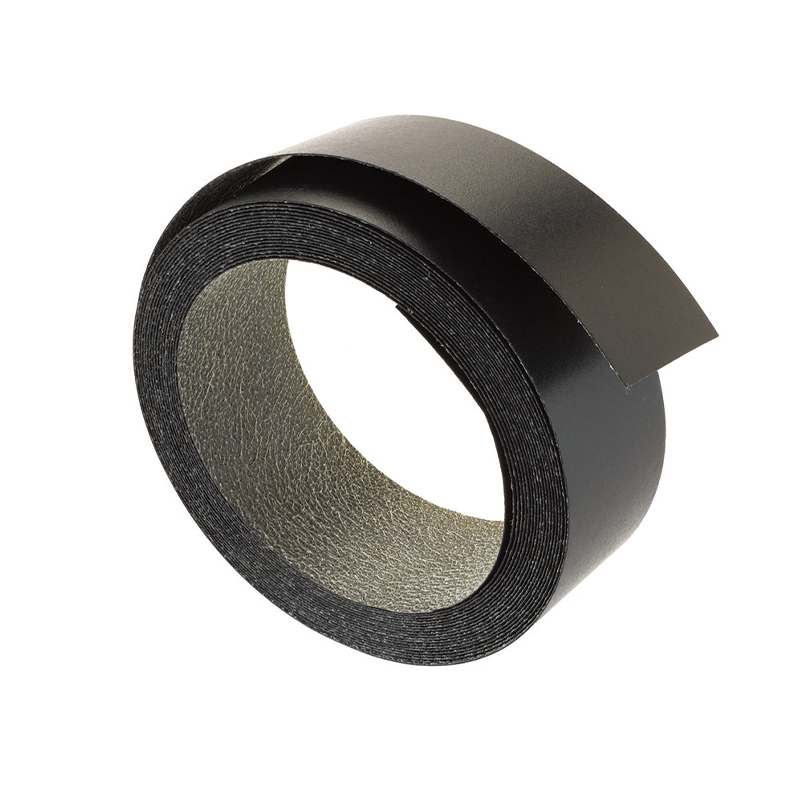
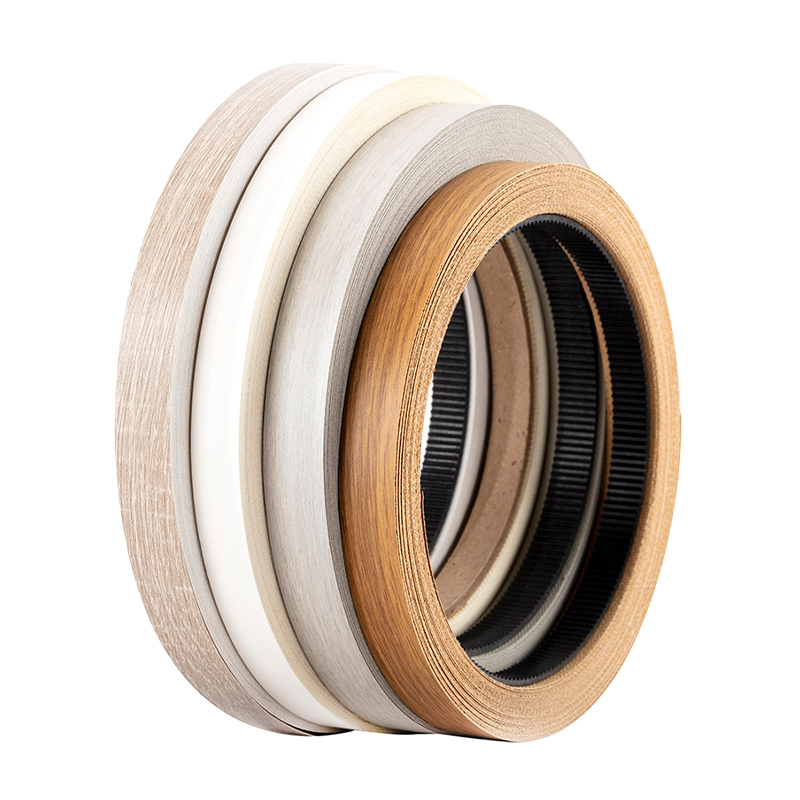
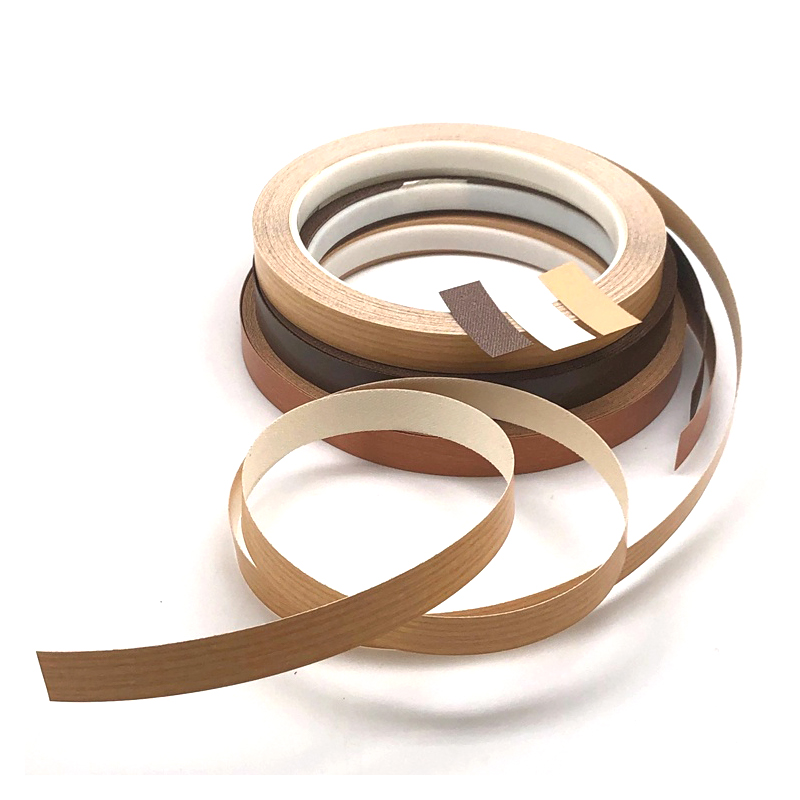
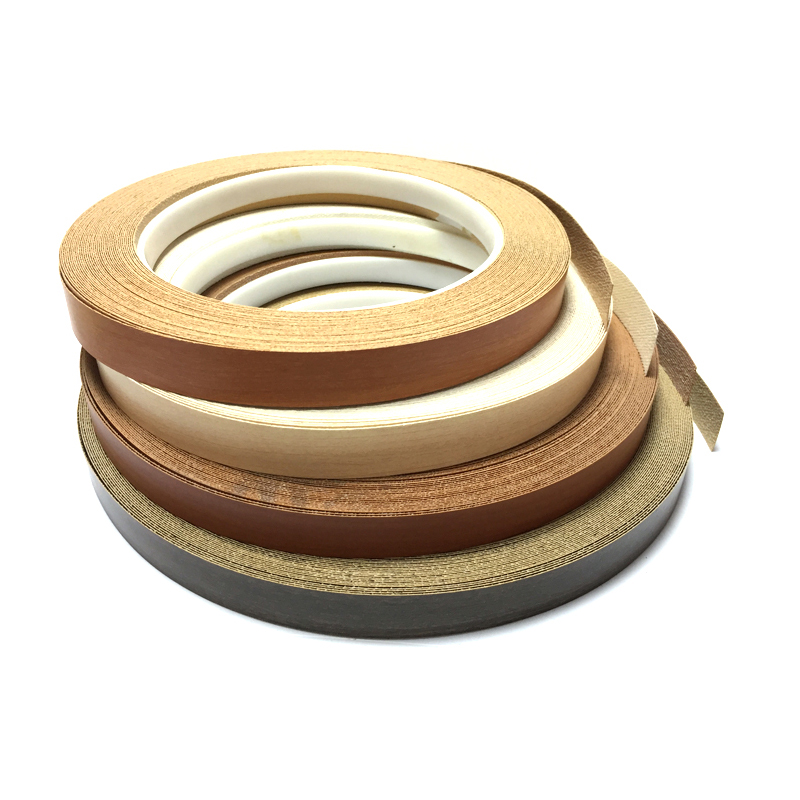
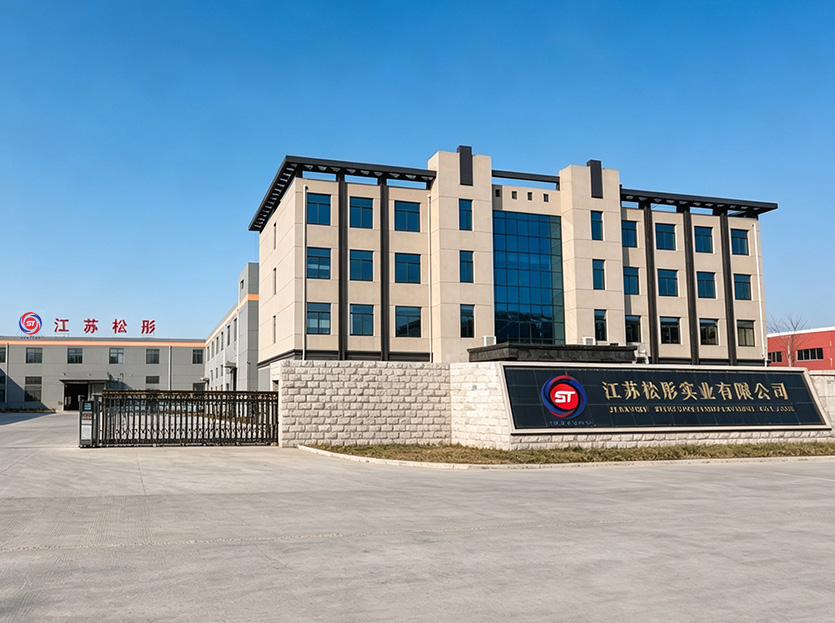



Shanghai Suntung Industry Co., Ltd. is a Pre-glued Melamine Edge Banding manufacturer working from a 21,500 m² production base in Taizhou, Jiangsu, with edge banding production running since 2005. Every roll leaves our lines with a factory-applied EVA hot melt adhesive layer already bonded to the back, so an MDF or particleboard edge can be sealed with a household iron, a portable edge banding tool or a light-duty automatic machine — no separate glue pot, no open adhesive at the workstation.
The range is built for cabinet makers, panel furniture plants, interior fit-out contractors and distributors who need a decorative edge that installs quickly, matches the board face and holds its appearance through trimming, transport and daily use.
- Edge banding production since 2005; export shipments to more than 90 countries
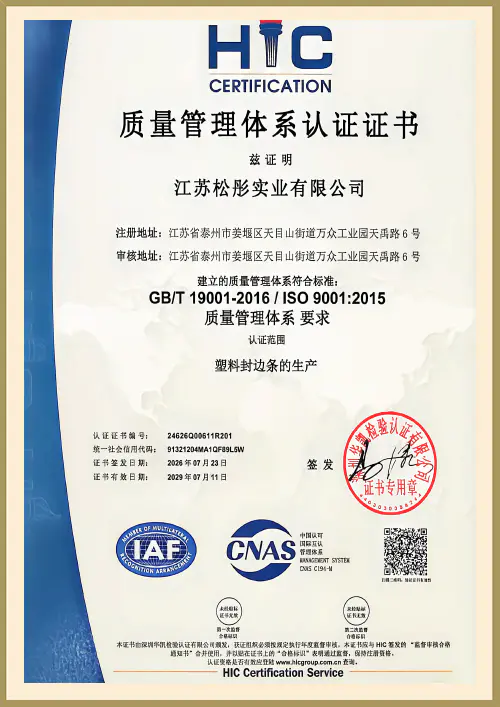
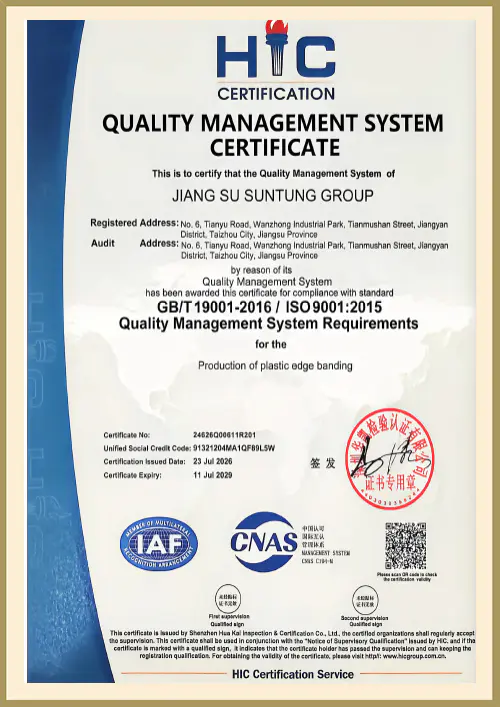
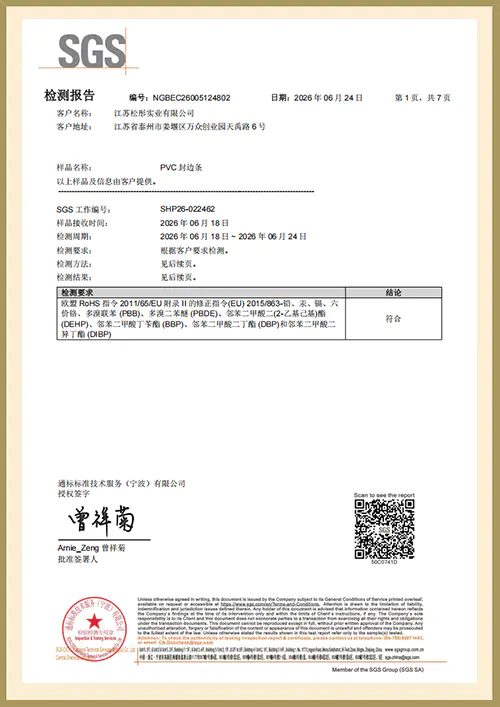
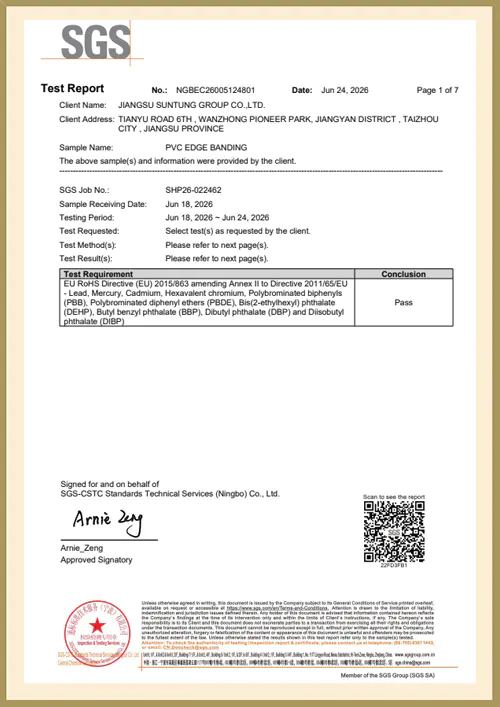
- ISO 9001:2015 certified; EU RoHS compliant, with SGS test reports available against project requirements
- 25 million meters monthly output across 23 automatic lines
- Long-standing supply to domestic home furnishing brands including Haier and Mengtian Group
- Shipments from the Port of Shanghai
How the Pre-Glued Construction Works
The strip is a layered paper system rather than an extruded plastic profile. A printed, melamine-impregnated decorative face carries the colour or wood grain; the base paper body gives the strip its body and bending behaviour; a primer layer controls how evenly heat reaches the adhesive; and the hot melt adhesive is applied as a controlled film on the reverse face.
- Decorative face: printed décor matched to an approved panel sample, with the gloss level and emboss held to the same master
- Base paper body: paper-based construction tuned so the strip bends and trims without cracking along a straight edge
- Primer layer: applied on automated glue application equipment for uniform coverage, so the heat path through the strip stays consistent roll to roll
- EVA hot melt adhesive: factory-applied coat weight matched to the application method — iron, hand tool or machine
Because the adhesive is already on the strip, the installation variables reduce to three: heat, pressure and time in contact. Those three are what we set the adhesive coat weight and primer for, and what our pre-shipment machine tests simulate.
Range and Configuration Options
Pre-glued melamine sits inside our wider Melamine Edge Banding family, alongside non-glued and soft variants. Within this pre-glued category, the configuration is defined by décor, gloss, thickness, roll width, adhesive coat weight and roll format.
| Configuration area | What we produce | Typical application fit |
|---|---|---|
| Surface décor | Solid colours, wood grains, stone and abstract prints, matched to a physical board sample | Case goods, cabinet doors, shelving, shop and office fit-out |
| Gloss and texture | Matte, satin and texture-embossed faces, coordinated with the panel face gloss | Furniture where edge and face are viewed together in the same light |
| Thickness | Thin and mid gauges within the paper range used for pre-glued melamine (commonly around 0.5–1.0 mm, confirmed per order) | Straight panel edges; radius limited by the paper face rather than the adhesive |
| Roll width | Set from panel thickness plus trim allowance, cut on precision slitting equipment | 16 mm and 18 mm panel furniture, thicker built-up sections, custom sizes |
| Adhesive | EVA hot melt, factory-applied at a controlled coat weight | Iron-on repair, portable banders, light-duty automatic lines |
| Roll format | Standard coils, custom lengths and cores, private-label packing | Distributor stock, OEM kits, retail-ready packaging |
Application Fit and Material Boundaries
Pre-glued melamine is the practical choice where the edge must be finished quickly and the budget must stay lean: on-site furniture repair, custom joinery, small-batch production, showroom touch-ups and interior fit-out work where hauling boards to a machine shop is not viable. It bonds readily to MDF, particleboard and plywood edges with a clean, square cut.
- Strong fit: straight edges, flat panel faces, low to medium abrasion exposure, rapid repair and refit work
- Needs review: tight radii, heavy-wear commercial tops and edges exposed to moisture, where a thicker or different material usually serves better
- Alternative within our range: Non-glued Melamine Edge Banding where the line runs its own adhesive system
- Alternative for durability: Pre-Glued PVC Edge Banding for higher impact and water resistance on the same hand-tool or machine setup
Processing: Activation, Pressure and Trimming
The adhesive film melts into the panel edge under heat and pressure, then sets as it cools. Heat source, contact time and roller pressure need to be in balance; overheating scorches the printed face, while under-heating leaves a short glue line that opens later.
- Iron application: a domestic iron through a protective cloth, moved steadily along the edge, followed by firm rubbing while the adhesive is still fluid
- Portable bander or hot-air tool: feed rate and air temperature set so the adhesive glosses but the paper face does not discolour
- Machine integration: on light automatic lines, roller pressure and line speed matter more than temperature alone once the strip is at the activation point
- Trimming: flush trimming after cooling; a sharp, correctly set cutter protects the printed face from tear-out at the top edge
- Operator safety: iron and hot-air nozzles present burn risk, trimmed strips leave sharp paper edges, and adhesive fumes need local ventilation in enclosed workshops
Capacity, Colour Consistency and Repeatability
Our Taizhou base runs mixing, extrusion, calendering, printing, cutting, quality control and packing as separate departments, which is what allows a décor to be repeated across reorders rather than re-created each time. Output reaches 25 million meters per month across 23 automatic lines, with capacity for around 30 × 20GP containers monthly.
- Colour matching similarity of 95% or better against the approved master sample, checked against the board rather than a swatch alone
- Printing inks sourced from established brands for grain fidelity and colour fastness
- Precision slitting to hold roll width and cut tolerances on the specified dimension
- Standard colours and specifications held in stock for repeat call-off and fast replenishment
Quality Assurance and Acceptance
Checks run from incoming raw material through to pre-shipment, with the master sample as the reference at every stage. Adhesion and sealing are verified by running the strip under simulated production conditions before a batch is released.
| Characteristic | How we verify | Acceptance reference |
|---|---|---|
| Colour and gloss | Tone, texture and gloss checked against the approved master through production | Approved sample; ≥95% colour similarity |
| Décor print and emboss | Print clarity, grain continuity, emboss depth uniformity and surface flatness | Batch surface inspection record |
| Dimensions | Width and thickness measured after slitting and winding | Order specification |
| Adhesion and sealing | Machine test simulating customer production; bond strength and glue-line continuity | Pre-shipment edge banding test |
| Trimming and flexibility | Bending and trimming trials to catch cracking and face damage | Clean edge with intact print |
| Compliance documents | ISO 9001:2015 system certification; RoHS compliance; SGS test reports on request | Documents issued with the shipment |
Information We Use to Configure Your Solution
A quotation is prepared from the working point, not from a catalogue page. These are the inputs that let us fix thickness, width, adhesive coat weight, roll format and packing without a round of guesswork.
- Substrate type and panel thickness (MDF, particleboard, plywood), plus any radius on the profile
- Décor reference — a physical board chip or the panel brand and code the edge must match
- Required gloss level and surface texture on the edge relative to the face
- Strip thickness and roll width, or the panel thickness the width must cover with trim allowance
- Application method: iron, portable bander, hot-air tool or automatic line, with line speed where relevant
- Order pattern — first order, reorder colours and monthly call-off — and roll length or core preference
- Packing and labelling requirements, including private label and retail-ready presentation
- Destination port and the compliance documents required for import clearance
Samples are produced against the same master we hold for production, so an approved sample and the bulk order come from one reference point.
Customization, Packaging and Delivery
OEM and ODM work is handled by an in-house R&D and engineering team that develops from drawings and physical samples: custom colour, texture, size, surface and hardness are all open to specification. Rolls are wound, sealed and packed to the agreed format, then consolidated for container loading.
- Custom colour development and matching to third-party panel décors, including major European and regional board brands
- Custom dimensions, emboss patterns and adhesive coat weight by application
- Private-label printing, carton marking and mixed-container consolidation with profiles, adhesive and screw caps from our wider product list
- Export handled through Shanghai with an on-time delivery rate above 95% and stock held on mainstream colours for fast replenishment
Frequently Asked Questions
Which substrates does pre-glued melamine edge banding bond to?
MDF, particleboard and plywood edges with a clean, square cut are the standard case. The adhesive is an EVA hot melt, so the edge must be dry, dust-free and at workshop temperature; a chilled board pulls heat out of the glue line and shortens the open time, which shows up later as a loose edge.
Can it be applied without an edge banding machine?
Yes. The pre-applied adhesive is designed for activation by a household iron through a cloth, or by a portable bander and hot-air tool. The same strip also runs on light-duty automatic lines. We set the adhesive coat weight to the method you name on the order, because a hand iron and a machine do not deliver the same heat and pressure.
How do you match the edge to our board décor?
We work from a physical board chip or the panel brand and code, and match tone, grain, emboss and gloss together — a colour match that ignores gloss still reads as a mismatch on a finished cabinet. Production holds 95% or better similarity to the approved master, and the master sample is retained as the reference for reorders.
What thickness and roll width should be specified?
Thickness follows the edge profile and wear expectation — most pre-glued melamine work sits in the thin to mid paper gauges, with heavier gauges reserved for edges that take more handling. Roll width is panel thickness plus trim allowance. Give us the panel build-up and we return the width that trims flush without leaving a visible glue line.
Do you supply OEM colours and private-label packaging?
We do. Custom colour, texture, dimension and surface are developed from drawings and samples by our engineering team, and rolls can be packed under your label with your carton marking. Mixed containers combining edge banding with profiles, hot melt adhesive and screw caps are consolidated for distributors who prefer a single shipment.
Which documents accompany a shipment?
Our factory is ISO 9001:2015 certified and products are EU RoHS compliant, with SGS test reports and relevant compliance documents issued on request. Inspection records covering colour, dimensions, adhesion and trimming performance are held against the batch, so a reorder can be traced back to the same reference.


